When we imagine the Sahara, the mind often drifts to vast, undulating dunes of ochre sand and the profound silence of the desert night. However, amidst this austere beauty lies a vibrant world of color, texture, and creativity that has thrived for centuries. The artistic heritage of the Sahara is not merely decorative; it is a profound expression of survival, identity, and the enduring spirit of the people who call this harsh environment home. Every knot in a rug, every hammer strike on silver, and every molded piece of clay tells a story of adaptation and cultural pride. As we move through January 2026, the appreciation for these slow, handmade treasures is higher than ever, offering travelers a tangible connection to the desert's soul.
The Soul of the Sahara: More Than Just Souvenirs
To view Saharan crafts simply as souvenirs is to overlook their deep anthropological significance. For the nomadic tribes and the settled oasis communities, art has always been functional, spiritual, and communal. In a landscape where resources are scarce, nothing is wasted, and everyday objects are elevated to masterpieces through intricate decoration. The artisans, often working with techniques passed down through countless generations, embed their personal narratives and tribal history into their work. This connection between the maker and the object creates a living archive of the region's heritage, far more potent than any written record.
The creation of these items is rarely a solitary pursuit. It is a social fabric that binds communities together. Women gather to weave and sing traditional songs, while men cluster around forges or kilns, discussing community affairs. When you hold a piece of Saharan art, you are holding the result of communal joy, struggle, and resilience. For those looking to understand the depth of this culture, you can Explore Morocco and its diverse southern regions where these traditions are most alive.
Woven from History: Textiles and Rugs
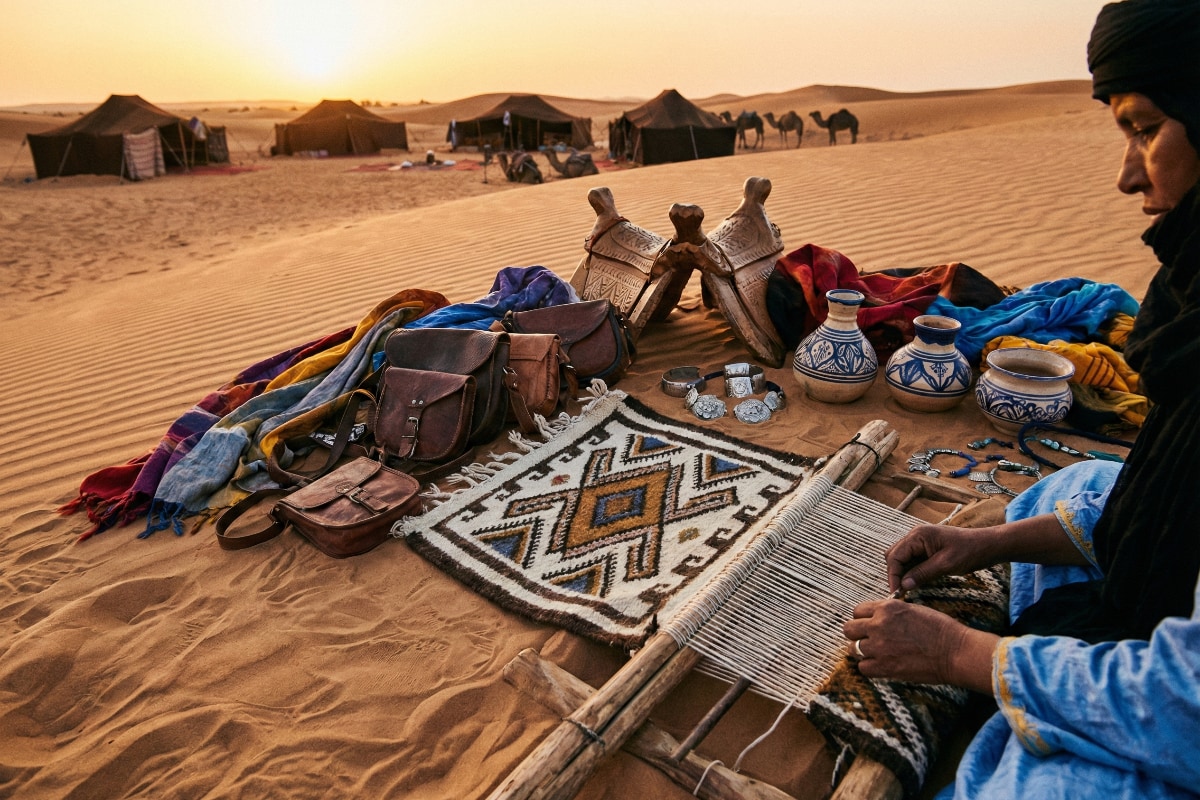
Perhaps the most iconic representation of Saharan craftsmanship is the art of weaving. The textiles produced in the desert regions are renowned worldwide for their durability, bold geometric patterns, and vibrant natural dyes. Unlike the mass-produced synthetic rugs found in modern department stores, Saharan rugs are crafted from locally sourced wool, camel hair, or agave fibers (sabra silk). The process begins long before the loom is set up, with the shearing of animals and the painstaking preparation of the fibers.
The symbolism within these textiles is a language of its own. A weaver does not choose a pattern at random; she writes a message. Diamonds may represent the protective eye against evil spirits, zig-zags can symbolize the flow of water or the dunes, and triangles often denote fertility. The colors, too, are drawn from the earth: saffron for yellow, indigo for blue, henna for red, and mint for green. These rugs serve multiple purposes in a nomadic tent—they are beds, partitions, and flooring, providing warmth during the freezing desert nights and insulation against the midday heat.
The Distinction of Styles
Travelers venturing into the desert will notice distinct variations in style depending on the tribe and geography:
- Hanbel: These are flat-woven kilims, lighter and easier to transport, making them ideal for a nomadic lifestyle. They often feature intricate embroidery and are used as blankets or wall hangings.
- Zanafi: originating from the High Atlas and the edge of the desert, these rugs are characterized by black and white geometric designs and a unique knotting technique that makes them reversible.
- Boucherouite: A testament to sustainability, these 'rag rugs' are made from recycled fabrics. They are incredibly colorful, abstract, and expressive, showcasing the ingenuity of the artisan.
Earth and Fire: Saharan Pottery
In the pre-Saharan regions, particularly in the Draa Valley, pottery is an ancient craft that utilizes the very earth of the riverbeds. The most famous example is the pottery of Tamegroute. This distinctive green ceramic is unique to the region and has been crafted by the same families for centuries. The secret lies in the glaze—a mixture of manganese, silicon, and copper—which, when fired in traditional wood-burning kilns, transforms into a spectrum of lush greens, ranging from deep emerald to olive.
The process is entirely manual. The clay is dug from underground galleries to ensure purity, trampled by foot to remove air bubbles, and thrown on a wheel powered by the potter's kick. The resulting pieces are rustic and imperfect, bearing the marks of the fire and the maker's hands. These imperfections are what give Tamegroute pottery its character and authenticity. Beyond the famous green glaze, unglazed terracotta is also widely produced for cooling water and storing grain, proving that functionality remains at the core of Saharan design.
Silver and Stones: The Jewelry of the Nomads
While gold is often associated with urban luxury, silver is the metal of the desert. For the Tuareg and Berber people, jewelry serves as both adornment and a portable savings account. In times of hardship, a heavy silver bracelet or a necklace of amber and coral can be traded for grain or livestock. But beyond economics, jewelry is a powerful talisman. The artisans who work with metal are viewed with a mix of respect and awe, as they manipulate fire and metal to create objects of power.
The designs are geometric and sharp, reflecting the landscape. The famous "Cross of Agadez" is a recurring motif, representing the four cardinal directions—a compass for the soul in a land without landmarks. Etchings on the silver often mimic the tracks of gazelles or the constellations used for navigation. To witness the intricate process of jewelry making or to try your hand at a workshop, you can browse our curated Experiences that connect travelers directly with master silversmiths.
A Guide to Authentic Saharan Materials
Understanding the materials used in Saharan crafts helps in appreciating their value and authenticity. Here is a breakdown of common elements found in desert artistry:
| Material | Common Uses | Characteristics |
| Sheep Wool | Rugs, blankets, cloaks (Djellaba) | Durable, warm, retains dye well. The foundation of most textiles. |
| Sabra Silk (Agave) | Cushions, throws, embroidery | Shiny, vegetable-based silk. Cool to the touch and fire-resistant. |
| Camel Leather | Bags, sandals, poufs | Extremely tough and durable. Often embroidered with geometric patterns. |
| Tamarisk Wood | Furniture, beams, carved boxes | A dense, hardy wood native to the desert, resistant to termites. |
| Henna | Dyes for wood, leather, and skin | Provides rich orange-red tones and is believed to bring good luck (Baraka). |
Supporting the Makers: The Economic Impact
The beauty of Saharan crafts extends beyond aesthetics; it is the lifeblood of the local economy. In many oasis towns and desert villages, agriculture is difficult due to water scarcity, making craftsmanship a vital source of income. When travelers purchase authentic goods, they are directly supporting the livelihoods of families and ensuring the survival of these ancient skills. This economic independence is particularly empowering for women in rural cooperatives, who are often the primary weavers and textile artists.
Sustainable tourism plays a crucial role here. By choosing to buy directly from artisans or reputable cooperatives rather than mass-market souvenir shops, visitors ensure that the revenue stays within the community. This financial validation encourages the younger generation to learn these difficult trades, preventing the knowledge from dying out in an increasingly digital world. It transforms the transaction from a simple purchase into an investment in cultural preservation.
Preserving Heritage in a Modern World
As the world becomes more homogenized, the distinct, hand-hewn character of Saharan crafts becomes increasingly precious. These objects are antidotes to the disposable culture of the modern age. They remind us of a time when objects were made to last, to protect, and to tell a story. Whether it is a rug that took three months to weave or a silver fibula hammered out under the desert sun, these crafts are physical manifestations of the desert's enduring spirit.
Exploring the Sahara offers a unique opportunity to witness this artistry firsthand. It is an invitation to look beyond the sand and see the vibrant culture that thrives within it. By engaging with these crafts, we do not just observe history; we help keep it alive for the future.